
Understanding the meaning of Yajna, the purpose of traditional homas, and the care that should guide every ritual recommendation.
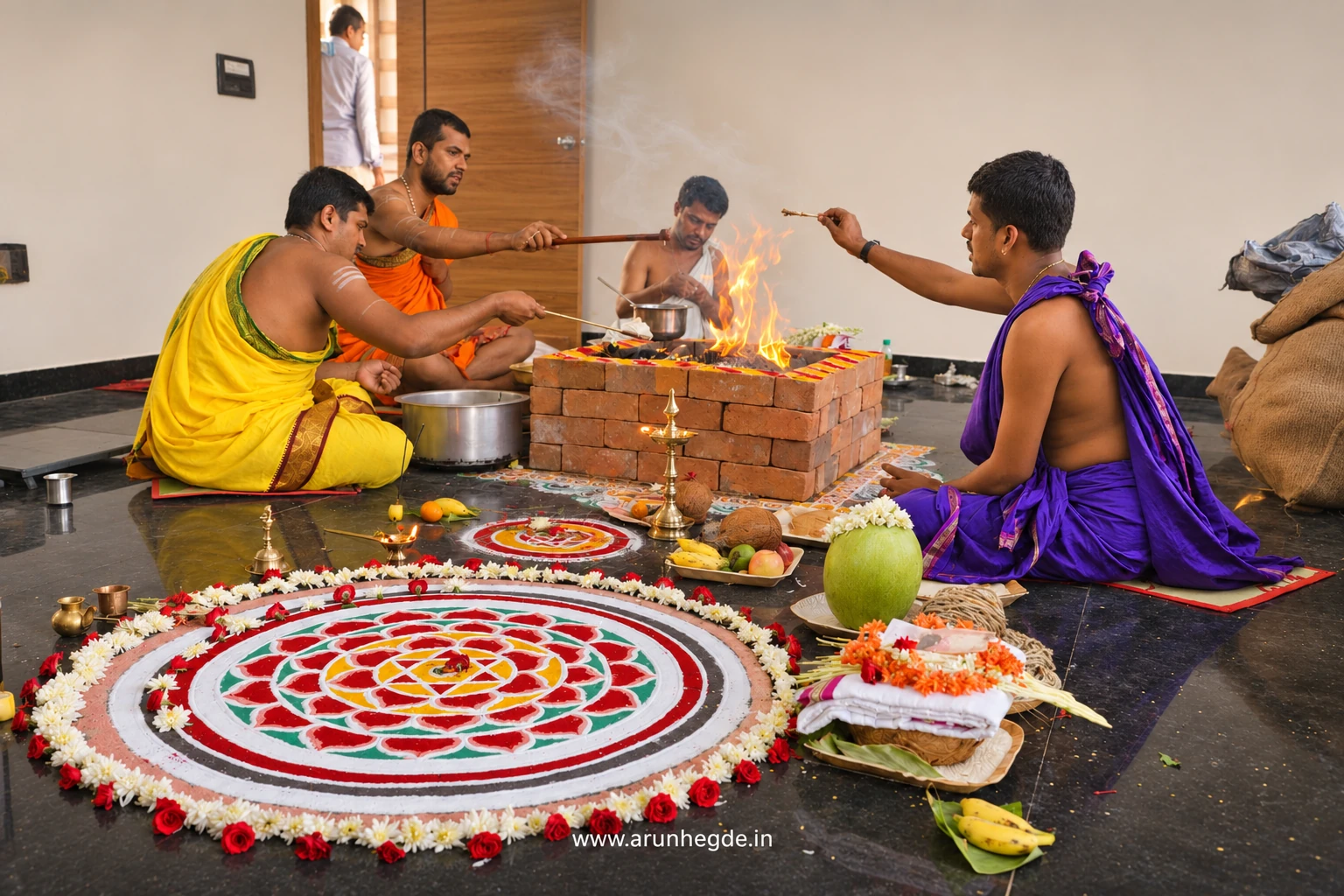
Participants taking part in a traditional homa ceremony.
When a family gathers before the sacred fire, it brings something deeply personal: gratitude, a hope for a child, concern for a loved one, the beginning of a new home, or a prayer for strength during a difficult period. Yajna gives these intentions a sacred form through mantra, offering and participation.
For a seeker, understanding the meaning of the observance is an important part of taking part in it. The name of a homa may be familiar, while its purpose, preparation and place in spiritual life remain unclear. Thoughtful guidance should help a family understand what is being performed, why it is being considered and how to participate with sincerity.
What Yajna means
Yajna is a sacred act of offering and worship. In a fire ritual, prescribed offerings are placed into the consecrated fire while mantras are recited. Homa, also called havan in many communities, commonly refers to this practice of offering into fire. The terms overlap in everyday usage, while particular rituals have their own procedures and traditions.
Yajna also carries a wider meaning of dedication. Study, prayer, hospitality, service and the fulfilment of our responsibilities can express the same spirit of offering. This wider understanding helps us see ritual as part of the way we live.
Agni and the sacred offering
The Rigveda begins with praise of Agni, the deity of fire:
अग्निमीळे पुरोहितं यज्ञस्य देवमृत्विजम् । होतारं रत्नधातमम् ॥
The verse honours Agni as the divine priest of the yajna, the invoker and bestower of treasures. Within the Vedic understanding, Agni connects the offering with the deities to whom it is addressed. Rigveda 1.1.1
The ceremony brings together several elements. Sankalpa expresses the intention of the observance. Mantra gives voice to worship. Ahuti is the offering placed into the fire. The person or family participating brings attention, reverence and a willingness to follow the guidance of the officiating priest.
Care in recitation and procedure belongs alongside inner sincerity. A meaningful observance invites us to give our attention fully, to acknowledge what we have received and to consider how we will use our life responsibly.
The spirit of Yajna in daily life
The traditional Pancha Mahayajnas, or five great offerings of household life, show the breadth of this understanding:
Brahma Yajna: sacred study and teaching, honouring the knowledge received from teachers and sages.
Deva Yajna: worship and offerings to the Divine.
Pitr Yajna: remembrance of ancestors and offerings made with gratitude.
Bhuta Yajna: offerings to other living beings.
Manushya or Nri Yajna: hospitality and the respectful care of guests. Manusmriti 3.70 and 3.81
These duties remind us that our life is sustained by many relationships. Ritual finds a place beside learning, gratitude, generosity and care.
The Bhagavad Gita describes a sattvic yajna as one performed according to the prescribed practice, with the mind settled on duty and without demanding a reward. This is a valuable guide to the attitude with which we approach worship. Bhagavad Gita 17.11
Yajna as a traditional remedial observance
Within Jyotisha and ritual practice, parihara refers to a remedial observance, and shanti to rites of pacification and peace. Following an individual horoscope assessment, a practitioner may consider a Graha Yajna or another suitable observance. Such practices can also include mantra japa, worship, charitable giving and other forms of religious discipline. Traditional Shanti observances
A dosha is a concern identified within a particular astrological or ritual framework. Its significance needs to be explained in context. The decision to recommend a homa should take account of the concern, the tradition followed, the purpose of the observance and the family's circumstances.
A family should be able to ask: Why is this ritual being suggested? What prayer does it express? Is a simpler observance appropriate? What preparation and expense are involved? Clear answers allow participation to grow from understanding and willingness.
The purpose of a spiritual remedy is to seek divine grace through prayer and disciplined practice. Its recommendation should support thoughtful action, personal responsibility and confidence, without promising a fixed result.
Homas and their traditional purposes
The following descriptions explain the devotional intentions associated with the observances. The precise mantras, materials and sequence depend on the ritual tradition followed.
| Observance | Traditional intention |
|---|---|
| Graha Yajna or Navagraha Shanti | Worship connected with the nine grahas, considered in relation to an individual's horoscope and prayers for peace during challenging periods. |
| Mrityunjaya Homa | Worship of Lord Shiva through the Mrityunjaya tradition, with prayers for wellbeing, longevity and courage in times of difficulty. |
| Vastu Yajna | Worship associated with a site or dwelling, seeking blessings for peaceful habitation, often in connection with a new home or a Vastu observance. |
| Rakshoghna Homa | A protective rite associated with the ritual preparation and sanctification of a place, including certain building ceremonies. |
| Aghorastra Homa | A specialised observance invoking Aghora, a form of Shiva, with prayers for protection and pacification. |
| Maha Sudarshana Homa | Worship associated with Lord Vishnu's Sudarshana, with prayers for protection and the removal of obstacles. |
| Mahaganapati Homa | Worship of Lord Ganesha, seeking blessings for auspicious beginnings and the removal of obstacles. |
| Shri Sukta Homa | Worship of Goddess Lakshmi through the Shri Sukta, with prayers for auspiciousness, sustenance and prosperity. |
Traditional Shanti observances · Vastu and Rakshoghna observances at Sringeri · Agni Purana 321 on Aghorastra · Shri Sukta in Lakshmi Homa
For a home or property, ritual guidance should be considered alongside practical responsibilities for the building and its occupants. A Vastu Yajna expresses a sacred intention for the dwelling; questions about construction, structural safety and repairs belong with the relevant building professionals.
Nakshatra Shanti and the welcome of a child
A child's birth is an occasion for love, gratitude and responsibility. Nakshatra Shanti is a traditional observance considered in certain birth circumstances, with prayers for the child's wellbeing and the peace of the family.
Families may ask about births under Ashlesha, Mula, Jyeshtha, Dhanishtha or Krittika, among other nakshatras. These names should be discussed in the context of the family's tradition and the actual birth details. Traditional rules can distinguish particular portions of a nakshatra, its pada or quarter, and specific periods of time. A star name by itself does not explain every ritual consideration. Dharma Sindhu on birth-related Shanti
Every child deserves to be welcomed with love. A birth star should never become a label of blame or a reason to treat a child as harmful to the family. Where a Shanti observance is followed, it should be explained as a prayer offered with care and affection.
Balagraha Dosha Shanti
Balagraha Dosha Shanti belongs to traditional observances concerned with the protection and wellbeing of children. Its terminology should be explained within that religious context. It is not a medical diagnosis or an explanation for a child's illness, development or behaviour. Such concerns require appropriate professional assessment.
Durva Ayushya Homa
Durva Ayushya Homa, also written Doorva Ayushya Homa, is offered as a prayer for long life and wellbeing. The occasion, method and participation of the family are determined according to the practice followed. Its place is one of blessing, prayer and loving concern for the child.
Dhanvantari Homa and prayers for wellbeing
Dhanvantari Homa is dedicated to Lord Dhanvantari, honoured in Hindu tradition in association with Ayurveda and healing. Families seek this observance as a prayer for health and wellbeing, including during illness or recovery. Its purpose should be understood as devotional support. Dhanvantari Homa tradition
Rituals for wellbeing do not replace medical assessment, prescribed treatment or timely care for a child. A person who is unwell should receive appropriate medical attention while the family pursues its religious observances. NCCIH guidance on care for children
What guidance for Yajna and Homa involves
A considered recommendation begins with listening. The occasion may be a new home, a family observance, an astrological enquiry or a wish to offer a particular prayer. The discussion should make both the spiritual purpose and the practical arrangements clear.
Understand the purpose. Discuss the occasion, the family's concerns and any relevant customs. Where Jyotisha is involved, accurate birth details and the relevant horoscope can be considered.
Explain the proposed observance. Clarify its intention, the tradition followed, why it is suitable and what participation involves.
Agree the arrangements. Confirm the date, venue, expected duration, priests, materials and total charges before making a commitment. Clarify payment, rescheduling and cancellation terms.
Prepare the participants. Explain the main stages in a language the family understands, together with any preparation appropriate to their circumstances. The venue should allow safe management of the fire and suitable ventilation.
Discuss what follows. Explain any prayer, japa, charity or other observance recommended afterwards, and how questions about it can be addressed.
Families living outside India can begin by sharing their location, time zone, preferred language and the occasion. The form of guidance and any arrangements for participation should then be discussed individually.
Carrying the offering into daily life
A yajna gives a family an occasion to gather, pray and renew its sense of purpose. Its meaning can continue through the way we speak, care for one another, fulfil our duties and offer help.
My aim is to help seekers understand the tradition and participate with faith, clarity and humility. When the meaning of an observance is understood, the family can approach it with a willing heart and carry its spirit into everyday life.
For guidance on a suitable Yajna, Homa or Shanti observance, enquire with Vidwan Arun Hegde through ArunHegde.in.