
An introduction to mantra, japa and the relationship between sacred sound, meaning and inner practice.
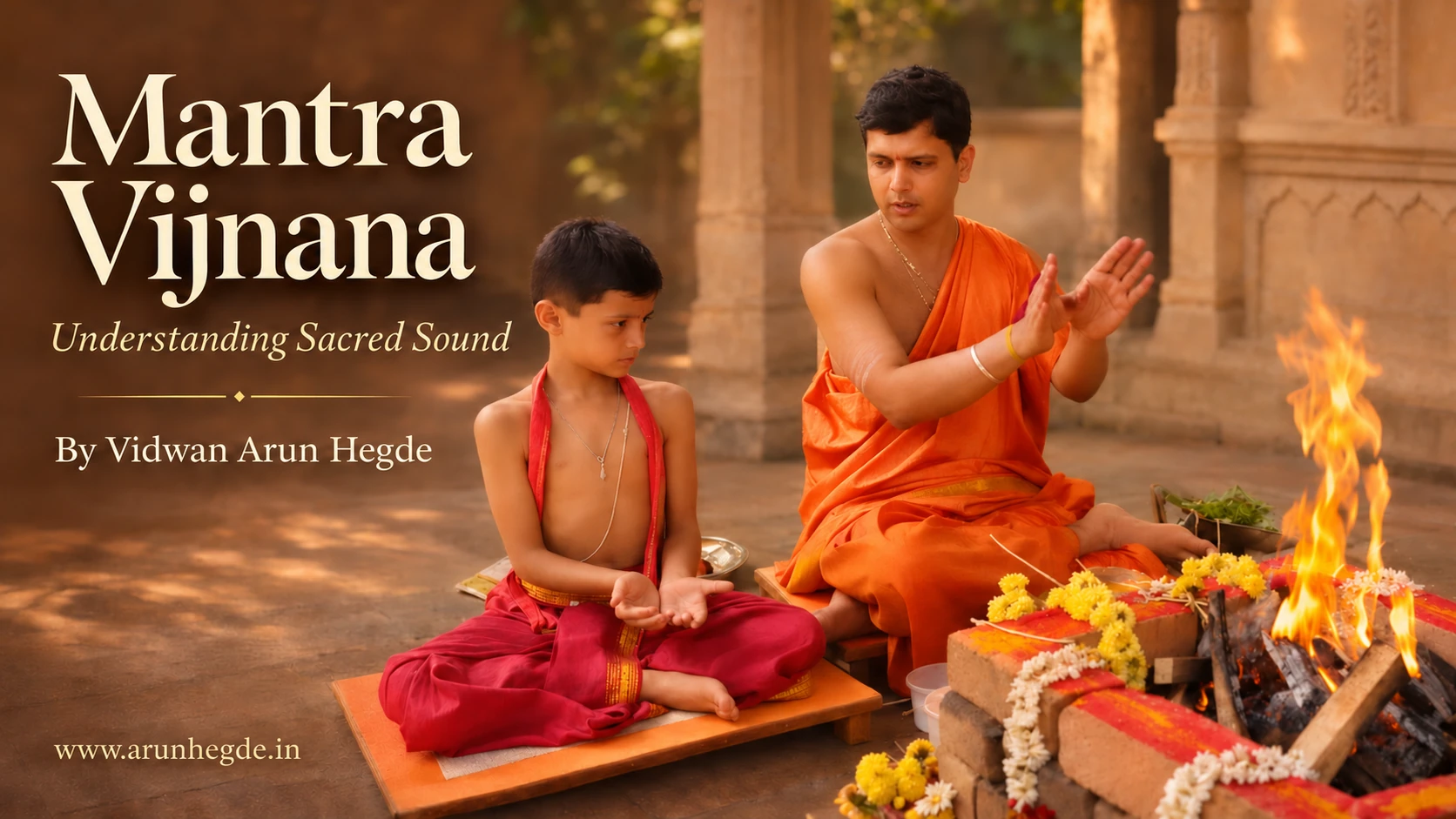
A sacred verse heard in childhood, a prayer offered at home, or a divine name repeated in quiet devotion can hold a deep place in a person’s life. Such moments invite us to consider how sound becomes part of spiritual practice.
In Hindu traditions, mantras accompany worship, meditation and many significant occasions in life. Their study brings together language, inherited knowledge, devotion and disciplined attention. Mantra Vijnana invites us to explore these connections with care.
Here, vijnana refers to an understanding of mantra within its traditional spiritual setting: its sound, its meaning, the way it is learned, and the purpose with which it is practised.
What is a mantra
A mantra is a sacred syllable, word or sequence of words used in worship, contemplation or spiritual discipline. Its significance comes from the tradition in which it is received and the way it is understood and practised.
A familiar traditional explanation expresses its purpose in these words:
Mananāt trāyate iti mantraḥ.
“That which protects through contemplation is called mantra.”
This explanation connects mantra with manana, thoughtful reflection, and presents practice as a source of spiritual support. It invites the practitioner to return to a sacred meaning with attention and sincerity.
A person may first encounter a mantra through a family prayer, a temple, a teacher or the study of a text. Understanding grows through listening, asking questions and learning the setting in which that mantra is used.
Sound meaning and devotion
Sound and meaning have a close relationship in mantra practice. The syllables give the recitation its form, while understanding and devotion give the practitioner a way to engage with it.
In his discussion of Om, Patañjali connects its repetition with contemplation of what it signifies. Yoga Sūtra 1.27 describes Om as a designation of Īśvara, the Lord; the following sūtra brings recitation and contemplation together:
Tajjapas tadarthabhāvanam.
“Its repetition, together with contemplation of its meaning.”
This teaching gives us a useful way to approach the practice: attend to what is being recited and to the sacred meaning it carries.
The Sanskrit word devatā refers to the deity associated with a mantra. In some devotional traditions, the mantra is understood as the deity’s form in sound. Within that understanding, recitation expresses reverence, remembrance and a wish to draw closer to the divine.
Someone approaching the subject for the first time can begin by learning what a mantra addresses, how its tradition explains it, and why practitioners hold it sacred.
The Vedic seers and the care of recitation
Within the traditional Vedic account, the rishis, or seers, perceived and transmitted the mantras. The Veda is regarded as apauruṣeya, meaning that it is not the composition of a human author. The term śruti, “that which is heard,” belongs to this understanding of sacred revelation. These are teachings about how the Vedic tradition understands its own origin and authority. (Vedic Heritage Portal)
The care given to recitation reflects the importance of this inheritance. In formal Vedic chanting, pronunciation, the length of syllables and the inherited accents require careful learning. Śikṣā, the traditional discipline concerned with pronunciation and recitation, addresses this precision. (Vedic Heritage Portal on Śikṣā)
Different forms of sacred recitation have different conventions. A Vedic passage, a devotional name and a mantra taught within a particular lineage may each involve distinct instructions. A trained teacher can help a student understand the form being learned.
For a beginner, careful listening is a valuable starting point. Learning gradually gives room to hear unfamiliar sounds clearly, ask questions and receive correction.
Three forms of japa
Japa is the repeated recitation of a mantra, either aloud, very softly or within the mind. Traditional texts describe these three forms:
| Form | How it is practised |
|---|---|
| Audible japa — vācika | The mantra is spoken clearly enough to be heard. Attention rests on the recited syllables. |
| Soft japa — upāṃśu | The mantra is repeated very quietly, with slight movement of the lips or tongue. It may be barely audible. |
| Mental japa — mānasa | The mantra is repeated inwardly, attending to its sequence and meaning without an audible voice. |
These forms are described in the Śiva Purāṇa, Vāyavīya Saṃhitā, Uttara section 14.26–28.
The appropriate form depends on the mantra, the purpose of the practice and the instruction received. A teacher may guide a student in one form or explain how different forms are used in different settings.
In each case, there is an invitation to participate attentively: to listen when reciting aloud, to remain present during quiet repetition, and to follow the mantra carefully when practising inwardly.
Learning with guidance
A thoughtful introduction to mantra begins with understanding. The name of a practice, its meaning and the tradition to which it belongs all deserve attention.
Some practices are taught through specific instruction or initiation within a lineage. A teacher familiar with that tradition can explain the preparation and commitments involved. For someone exploring the subject, there is ample room to begin with study, listening and respectful questions.
Useful questions include:
What is the meaning and traditional context of this mantra?
How should its sounds be pronounced?
What form of recitation is appropriate?
Does this practice require particular instruction?
How can it be approached with a steady and sincere intention?
These questions allow learning to develop at a human pace. A student can gradually become familiar with the words, their significance and the discipline of attending to them.
From sacred words to inner understanding
The Amṛtabindu Upaniṣad offers a teaching on the relationship between sacred learning and spiritual realization:
Śabdabrahmaṇi niṣṇātaḥ paraṃ brahmādhigacchati.
“One deeply versed in the sacred word reaches the Supreme Brahman.”
Here, Brahman refers to ultimate reality. The verse expresses an Upaniṣadic understanding of sacred knowledge as a means of approaching that reality. Its language concerns spiritual realization.
For a learner, this offers a direction for reflection. Recitation can be approached alongside study, contemplation and devotion. Familiarity with a sacred text can gradually open into a deeper consideration of what it asks us to understand.
Bringing practice into daily life
Spiritual learning also invites reflection on everyday conduct. After a period of prayer or japa, we can consider the care with which we speak, the patience with which we listen and the respect we show to others.
Such questions give our learning a place in ordinary life. They encourage us to carry attention and sincerity into our relationships and responsibilities.
Mantra Vijnana invites a patient approach to sacred sound. We listen, learn its meaning, understand its setting and practise with the guidance appropriate to the tradition. Along the way, we remain students—willing to ask, willing to reflect and willing to learn.